Science
How do we know what's inside the Earth?
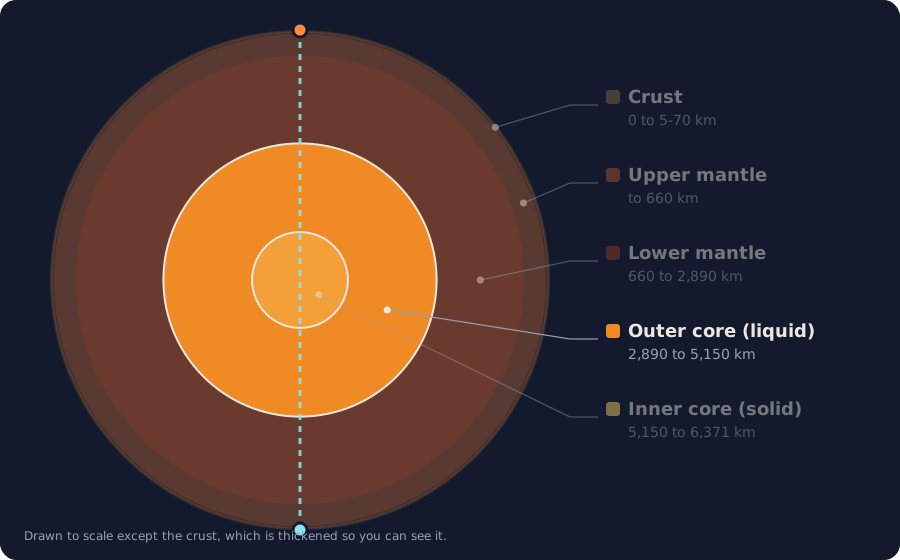
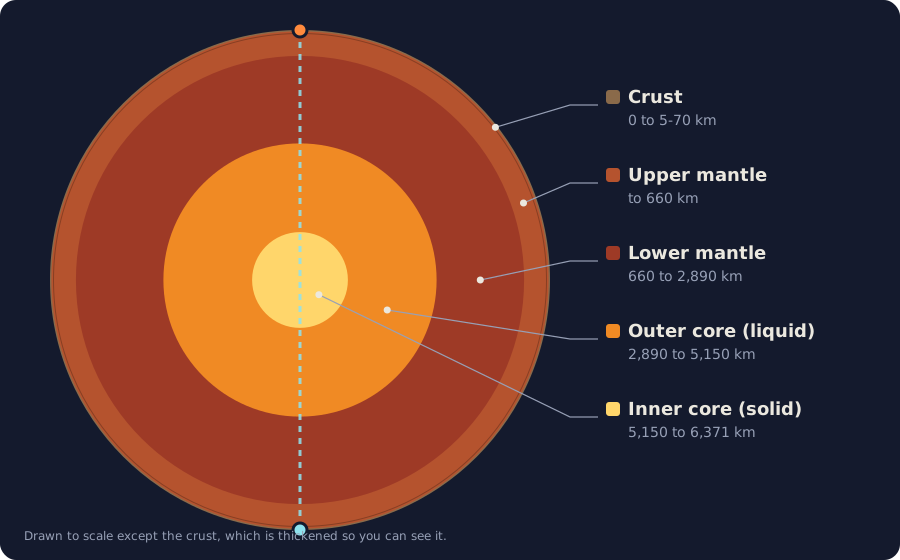
No human has been deeper than about 4 km, and no drill deeper than 12. So how can scientists say the center is a solid iron ball at 5,400 °C? The answer is a detective story told by earthquakes.
Clue 1: the Earth is too heavy
In 1798 Henry Cavendish measured the force of gravity between lead balls in his lab and used it to calculate the density of the whole Earth: about 5.5 grams per cubic centimeter. Surface rocks are only about 2.7. Something much heavier had to be hidden inside. Iron, common in the universe and in meteorites, was the obvious candidate.
Clue 2: earthquakes are X-rays for the planet
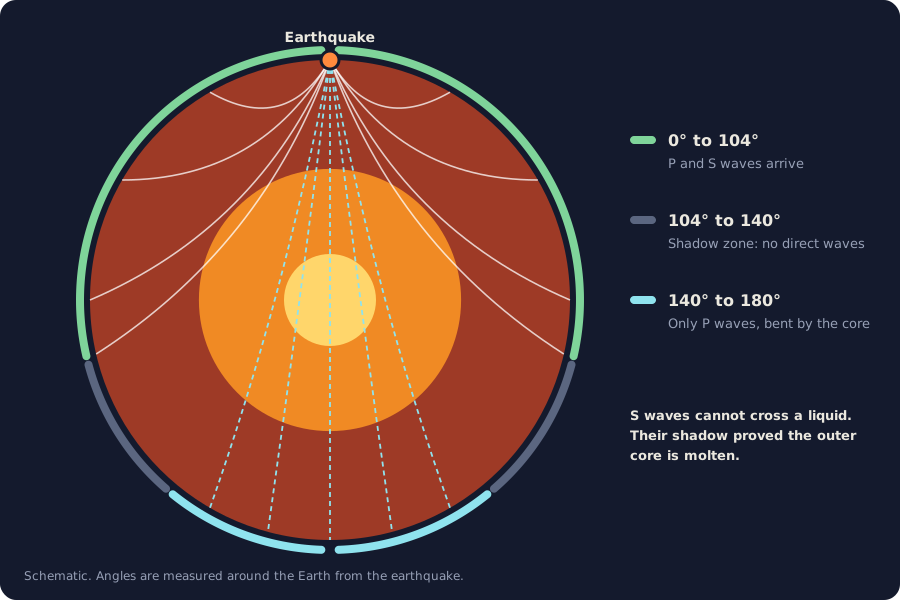
Every large earthquake sends waves through the whole Earth, and seismometers around the world record when they arrive. Waves change speed and bend when they pass into different materials, just like light entering water. By comparing arrival times from thousands of earthquakes, seismologists could reconstruct the inside of the planet.
There are two main types of waves. P waves (primary) push and pull the rock, like sound, and can travel through solids and liquids. S waves (secondary) shake the rock from side to side. A liquid cannot be sheared, so S waves stop dead when they hit one.
The discoveries, one by one
- 1906 Richard Dixon Oldham, a British geologist, notices that P waves passing near the middle of the Earth arrive late and concludes the Earth has a core.
- 1909 Andrija Mohorovičić, a Croatian seismologist, studies an earthquake near Zagreb and finds a sudden jump in wave speed a few tens of kilometers down: the boundary between crust and mantle, now called the Moho.
- 1913 Beno Gutenberg uses the shadow zone to place the top of the core at about 2,900 km.
- 1926 Harold Jeffreys shows that the core must be liquid, because S waves never pass through it.
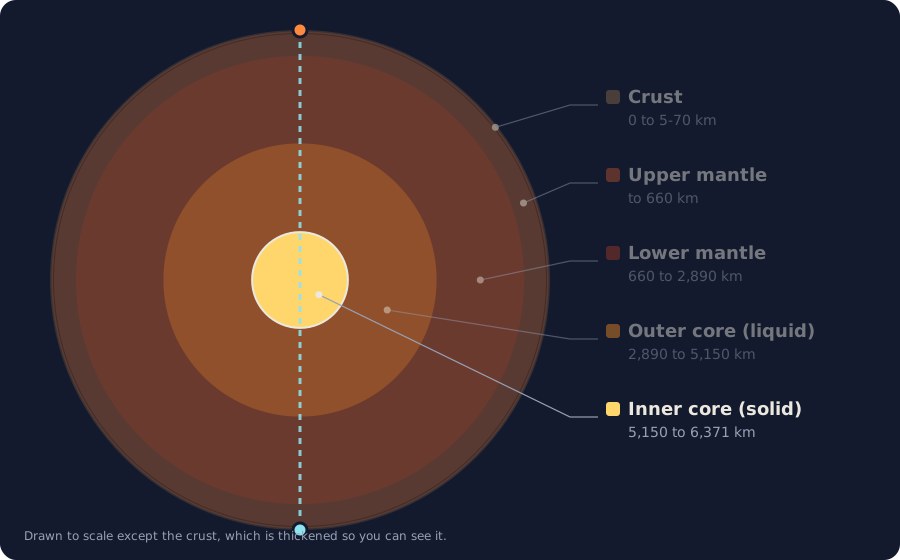
- 1936 Inge Lehmann, a Danish seismologist, spots faint P waves inside the shadow zone and explains them with a solid inner core.
- 1981 Adam Dziewoński and Don Anderson publish PREM, the standard model of density, pressure and wave speed at every depth, still in use today.
Clue 3: squeezing iron in the lab
Knowing the wave speeds is not enough to know the temperature. For that, scientists recreate core conditions: they squeeze tiny samples of iron between two diamonds, heat them with lasers and watch when they melt. These experiments show that iron at inner core pressure melts at over 5,000 °C, which sets the temperature scale for the center of the Earth.
Clue 4: the Earth rings like a bell
The largest earthquakes make the whole planet vibrate for days, like a struck bell. The tones depend on what the Earth is made of. In 1971 these vibrations confirmed that the inner core really is solid.
What we still don't know
How exactly the inner core spins, how old it is, what light elements are mixed into the iron, and what the strange structures at the bottom of the mantle are: these are still open questions. The inside of our own planet is harder to study than the surface of Mars.