Physics
How long would it take to fall through the Earth?
Suppose the tunnel exists, has no air, and you don't mind the heat. You jump in. What happens next is one of the most elegant results in physics.
You fall, then you glide up the other side
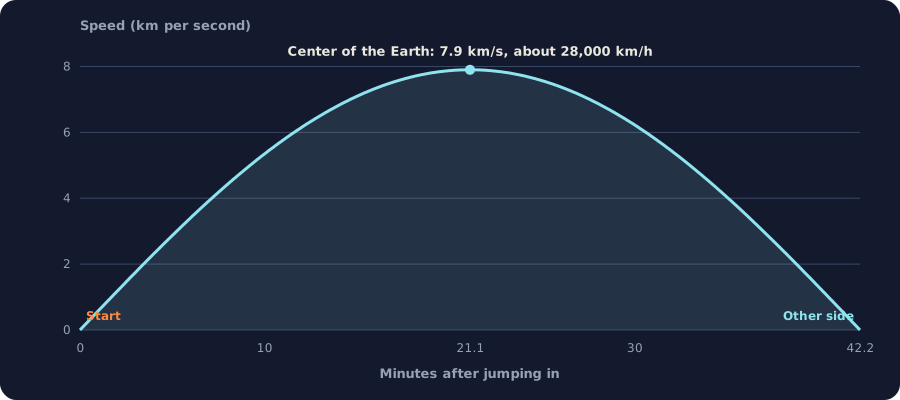
As you fall, gravity pulls you toward the center, so you speed up the whole way down. But gravity also gets weaker, because more and more of the Earth's mass is above you, pulling you back. At the center it is zero: you are weightless and moving at top speed. After that, gravity pulls you back toward the center and you slow down, arriving at the far surface at exactly zero speed, just in time for someone to grab you.
The magic number: 42 minutes
If the Earth had the same density throughout, the trip would take 42 minutes and 12 seconds. You would pass the center at about 7.9 km per second, around 28,000 km/h. Those numbers are no accident: 42 minutes is exactly half the time a satellite needs to orbit the Earth just above its surface, and 7.9 km/s is that satellite's speed. Falling through the planet and orbiting it are the same motion seen from different angles.
With the real Earth: about 38 minutes
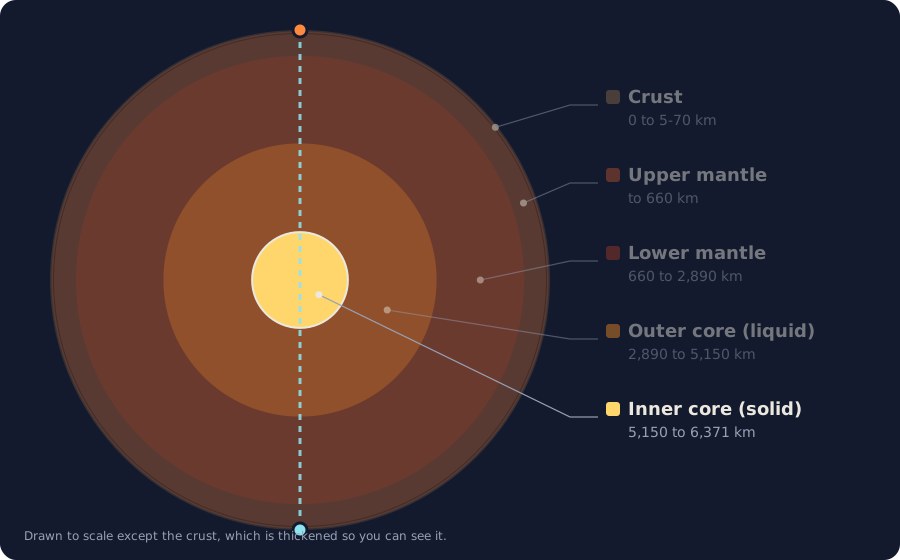
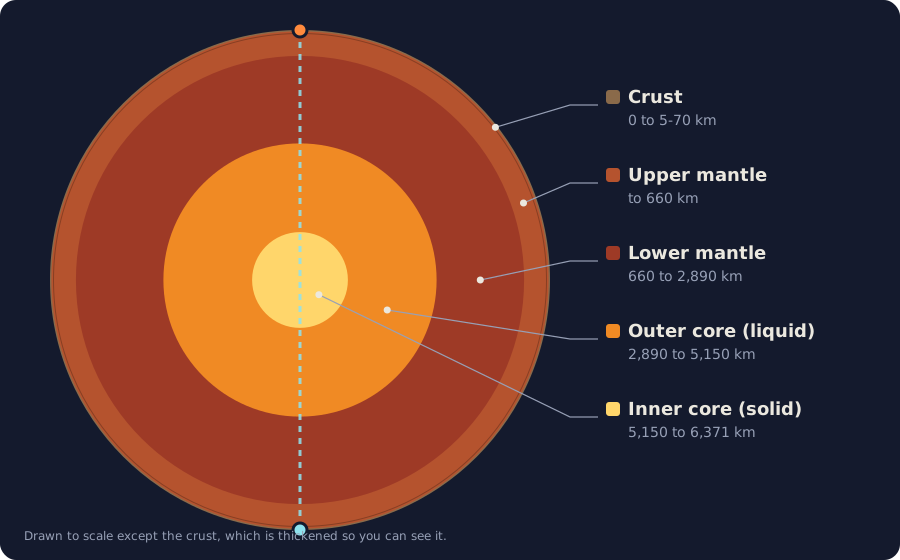
The real Earth is much denser in the middle because of its iron core. That means gravity actually gets stronger on the way down through the mantle, and you speed up faster. Using the measured density of each layer, the fall takes about 38 minutes.
Any straight tunnel takes the same time
Here is the surprising part. Dig a straight tunnel between any two points on the surface, say London and Paris, with no stops and no friction. A train rolling down it by gravity alone would also take about 42 minutes (in the uniform-density model), no matter how long the tunnel is. Longer tunnels are steeper, so the train goes faster. The idea is called a gravity train. Robert Hooke discussed it with Isaac Newton in the 17th century, Lewis Carroll put it in a novel in 1893, and physicist Paul Cooper worked it out in a scientific paper in 1966.
Why it will never happen
- Heat: about 5,400 °C at the center. No material known would survive.
- Pressure: over 3 million times air pressure would crush any tunnel shut.
- Rotation: the Earth spins, so a tunnel between two points not on the axis would swing sideways under you and you would hit the wall. Only a pole-to-pole tunnel avoids this.
- Air: with air in the tunnel, drag would stop you well short of the far side, and you would oscillate back and forth until you settled at the center.